


Establishing A Standard Dutch Hydroponics System
Nov 04, 2025
Leave a message
Establishing a standard Dutch hydroponics system in a 20,000-square-meter greenhouse is an excellent project to enhance agricultural modernization. This model allows for precise control of water and fertilizer, significantly improving crop yield and quality.
Below, I will provide you with a complete guide from equipment arrival to normal planting. The core installation process can be summarized as follows:
Preliminary preparations and infrastructure construction
After the main structure of the greenhouse is completed, the installation of the internal planting facilities becomes the core task.

1. Site survey and preparation
Ground levelness confirmation: Use a level to comprehensively measure the greenhouse ground to ensure overall flatness. The slope must be strictly controlled within 0.5% to guarantee the stability of the cultivation troughs after installation and the even distribution of nutrient solution.
Weed control layer installation: Lay a high-strength black and white weed control fabric (white side up) on the flat and compacted ground. This not only effectively suppresses weeds but also improves the light environment at the base of the plants through light reflection.
2. Precise layout and planning
Based on the greenhouse column structure and crop light requirements, determine the main operating path (approximately 80-100cm wide) and the orientation of the cultivation troughs.
Use a total station or precision laser rangefinder to lay out the lines, marking the precise locations of the cultivation trough support frame, main nutrient solution supply and return pipes, and working pool.
II. Installation of the cultivation trough system
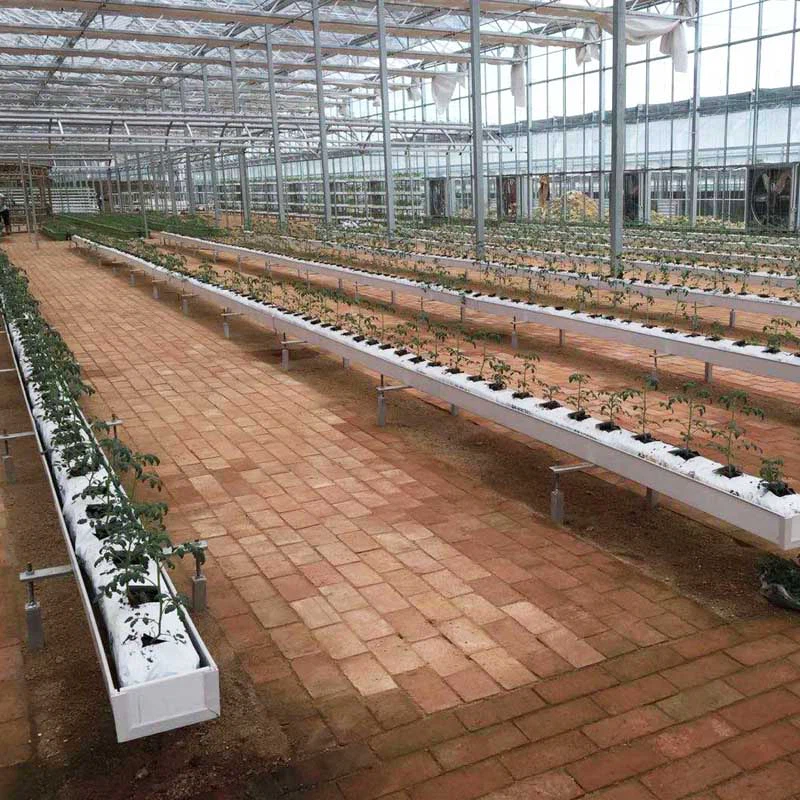
This is the core of the soilless cultivation system, directly related to the root growth environment of crops.
1. Support Frame Installation
Hot-dip galvanized angle iron or square tubing is used as the support frame material to ensure corrosion resistance.
Install the support frame according to the layout position. Typically, the cultivation trough frame is 50-60 cm high to facilitate daily management and root ventilation. The width of the trough is determined according to the crop being grown; for example, for tall crops such as tomatoes and cucumbers, the inner width of the trough is usually 30 cm.
2. Tank Construction
Preferred material: Use food-grade or environmentally friendly PVC board as the tank material, which is durable and safe for crops.
Tank Construction: Assemble PVC panels into a U-shaped or trapezoidal tank, with a depth of at least 20 cm. Drainage holes spaced approximately 50-60 cm apart should be pre-drilled at the bottom of the tank to ensure that excess nutrient solution can drain smoothly.
Laying the isolation layer: Lay a new polyethylene (PE) film with a thickness of not less than 0.1 mm in the tank. This step is crucial as it effectively isolates the cultivation substrate from the soil and prevents the spread of soil-borne diseases and pests.
III. Coconut Coir Substrate Treatment and Filling
High-quality substrate is the foundation for healthy root growth of crops.
1. Coconut Coir Selection and Pretreatment
Coconut Coir Standards: Imported coconut coir must meet the "Quarantine Requirements for Imported Organic Cultivation Media of the People's Republic of China," ensuring it is free of harmful organisms, weed seeds, and soil contamination, and that all materials are incapable of reproduction.
Buffering Treatment: Due to the high salt content of coconut coir, it must be rinsed multiple times with clean water before use. Afterward, it can be soaked in a balanced solution containing calcium (such as calcium nitrate) to stabilize its physicochemical properties.
2. Substrate Filling
Evenly fill the cultivation trough with the treated coconut coir, ensuring the filling height is 2-3 cm from the top of the trough to prevent overflow during irrigation.
Lightly compact the substrate during filling, but ensure good aeration and drainage; the initial porosity should be maintained at 60%-70%.
IV. Installation of Integrated Water and Fertilizer System
This is the nerve center for achieving precision agriculture and efficient management.
1. Head System Installation
Core equipment includes pressurized water pumps, automatic backwash filters, integrated water and fertilizer applicators (such as PRIVA or similar systems), and online pH/EC (acidity/conductivity) monitoring and calibration instruments.
Water source treatment: If the local groundwater has a high calcium content (such as the pH value of 7.8 in the case of Huzhu County), it is strongly recommended to install a reverse osmosis (RO) water treatment system to optimize water quality and improve water and fertilizer utilization.
2. Pipeline laying
Main pipe: PVC-U or PE pipes are usually used. The appropriate pipe diameter is selected based on the flow rate calculation (for example, the main liquid supply pipe can be of De63-De75 specifications).
Drip tape/drip arrow arrangement: Lay an individual drip arrow or drip tape on the coconut coir strip for each crop. Match the drip arrow spacing to the plant spacing (e.g., 25 cm for tomatoes) to ensure that each crop receives an equal and precise amount of water and fertilizer.
V. Installation of Planting Hanging System
It is mainly used for vining crops such as tomatoes and cucumbers to make full use of vertical space.
1. Installation of the vine suspension system
High-altitude steel wire: On the greenhouse truss, at a distance of approximately 2.2-2.5 meters directly above the cultivation trough, two high-strength galvanized steel wires are strung in parallel, with the spacing consistent with the direction of the cultivation trough.
Rope selection: Use UV-stabilized polypropylene rope, with one end fixed to the top steel wire via a hook, and the other end left with sufficient length for wrapping around the falling plant.
2. Auxiliary Facilities
Vine Clips: During crop growth, vine clips are used to secure the main vine to the hanging rope, guiding it to grow upwards.
Vine Droppers: When the plants grow too tall, vine droppers can be used to lower the hanging rope and the plant simultaneously, maintaining a reasonable plant height for easier management and harvesting.
VI. Planting and System Debugging
After all the hardware was installed, the crucial planting and debugging phase began.
1. Seedling Transplanting
Select healthy, disease-free seedlings (such as the chain-harvesting tomato variety Jiaxina) and cultivate them using a 72-cell soilless tray method.
Cut planting holes on the front of the coconut coir strip according to the predetermined plant spacing (e.g., 25 cm for tomatoes). Remove the seedling with its root ball from the tray and gently place it into the hole, ensuring full contact between the roots and the coconut coir.
2. System Initial Setup and Debugging
Irrigation Program Settings:
• Initial Stage After Planting: Set EC value to 1.6-2.0 mS/cm, pH value to 5.5-6.5.
• Vegetative Growth Stage: EC value can be gradually increased to 2.0-2.6 mS/cm.
• Peak Fruiting Stage: EC value can be maintained at 2.8-3.2 mS/cm.
• System Trial Run: Start the entire water and fertilizer system, check the uniformity of water output from each drip nozzle, check for leaks in the pipes, calibrate the pH/EC sensors, and ensure stable system operation.
VII. Suggestions for Daily Operation and Management
After the system is put into operation, meticulous daily management is key to ensuring high output.
Environmental control: Through the greenhouse environmental control system, daytime temperatures are maintained at 25-28℃, nighttime temperatures at 13-18℃, and suitable air humidity is maintained.
Nutrient solution management: Adhere to the irrigation principle of "timed and quantitative, small and frequent irrigation". Adjust the irrigation strategy dynamically according to the weather, plant growth stage and EC value of waste solution (usually 0.2-0.5 mS/cm higher than the input solution is within the normal range).
Plant management: Timely operations such as vine training, pruning, leaf thinning, and vine drop should be carried out to maintain good ventilation, light penetration, and growth vigor of the plant.
Integrated Pest Management (IPM): Insect-proof nets are hung at the top and bottom vents of the greenhouse, and yellow and blue sticky traps are hung indoors. Natural enemy insects can be introduced when necessary to build a green control system based on prevention.
Operating Parameter Reference Table
The following are key water and fertilizer parameter recommendations based on different crop growth stages, for daily

management reference:
* **Seedling Establishment Stage:** 1.6 - 2.0 5.5 - 6.5 Keep substrate moist to promote seedling establishment.
* **Vegetative Growth Stage:** 2.0 - 2.6 5.5 - 6.5 Irrigate frequently in small amounts, depending on weather and plant growth.
* **Flowering and Fruit Setting Stage:** 2.6 - 2.8 5.5 - 6.5 Ensure sufficient water to promote flowering and fruit setting.
* **Fruit Enlargement Stage:** 2.8 - 3.2 5.5 - 6.5 High water requirement; increase irrigation frequency and duration.
* **Harvest Stage:** Adjust according to variety. 5.5 - 6.5 Drip irrigation with clean water can be applied before harvest, depending on conditions.